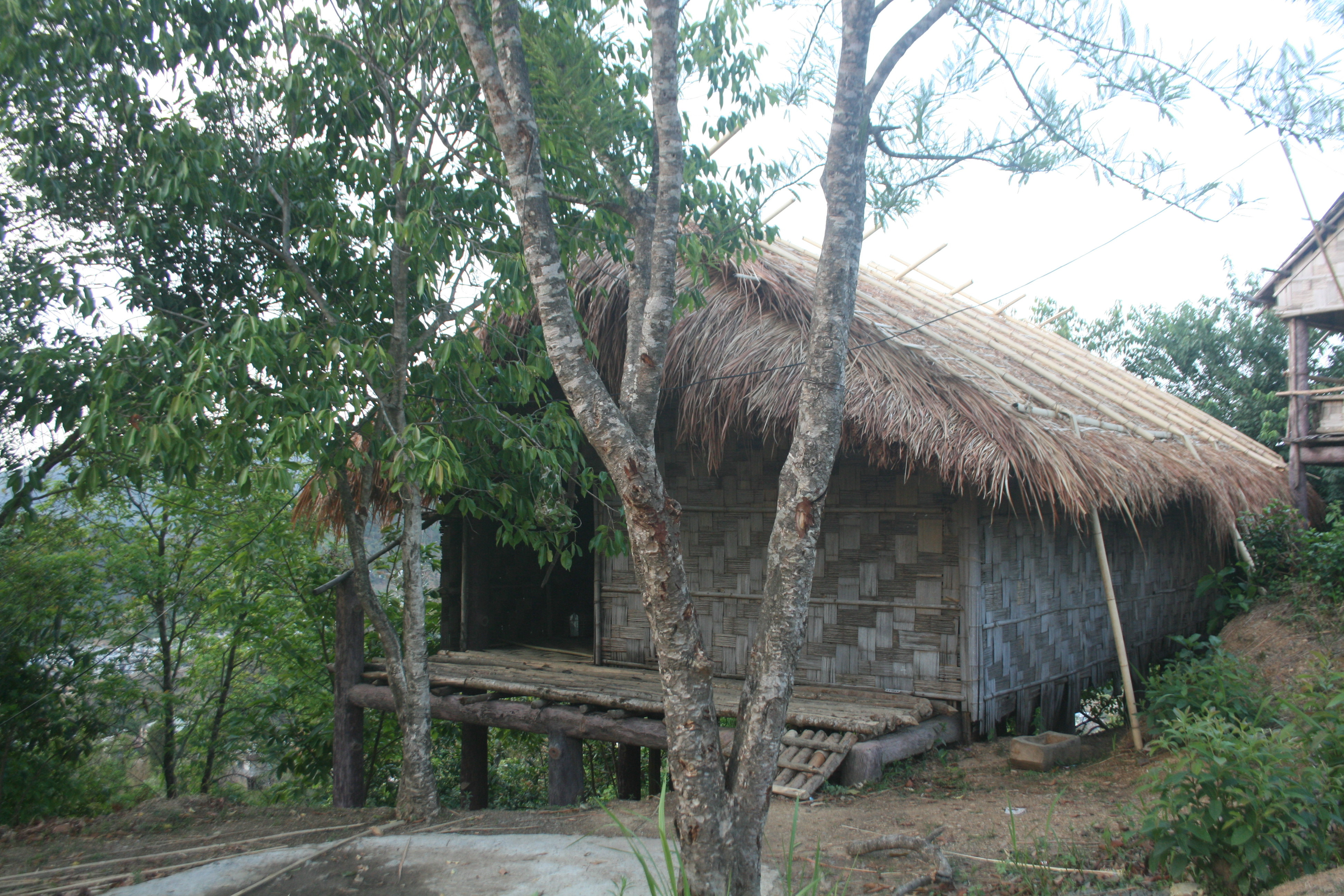
HNAMCHAWM IN
(COMMON PEOPLE'S HOUSE)
In the earlier Mizo society, all the village folks, save those belonging to the ruling clan are called Hnamchawm (Common People). The Hnamchawm In (Common people's house) doesn't have Seluphan in front of the house, nor does it have Leikapui. It doesn't have window and back door. It is a simple dwelling house in the true sense of the term.
In the front porch (Sumhmun), there is a wooden mortar and pestles on the one side and a small fowl-house, chicken-basket and basket for eggs on the other side. The inner wall of Sumhmun may have skulls of wild animals tucked on it, if the inmate of the house is a hunter. The door at the entrance has to be slided sidewise in order to open it. As one enters the house, one can see bamboo tubes used for carrying and holding water kept on the left side. Next to this, shelves are made out of bamboo to keep their utensils. A fire-place called Tapchhak is made on the other side near the wall. The fire-place is lined up with timber logs called Dawhthleng and Dawhchho on its side. The mound of earth at the back of the fire-place to protect the wall from fire is called Tapchal. A fire-shelf called Rapchung is also made above the fire-place. The space between the entrance door and Tapchhak is called Khum-ai. Normally a small bed is placed in this space and fire-wood are kept below this bed as this is near to the fire-place. Next to Tapchhak towards the back of the house is the place for Khumpui, the master-bed. One of the bed post of Khumpui, usually a big bamboo post is tied firmly to the cross-beam (Khanchhuk in Mizo). A hole is made on this post for keeping small articles. This post is called Tungchaw. By the side of Khumpui, a partition wall is made towards the back of the house. This wall is called Banglai. Knives, swords and guns are tucked on this Banglai. The room enclosed between Banglai and the back /rear wall is known as Banglaichhung. In between the cross-beam/tie-beams (Khanchhuak) above the floor (Chhuat) split bamboos are evenly arranged to serve as a shelf. This shelf is called Thehlan.