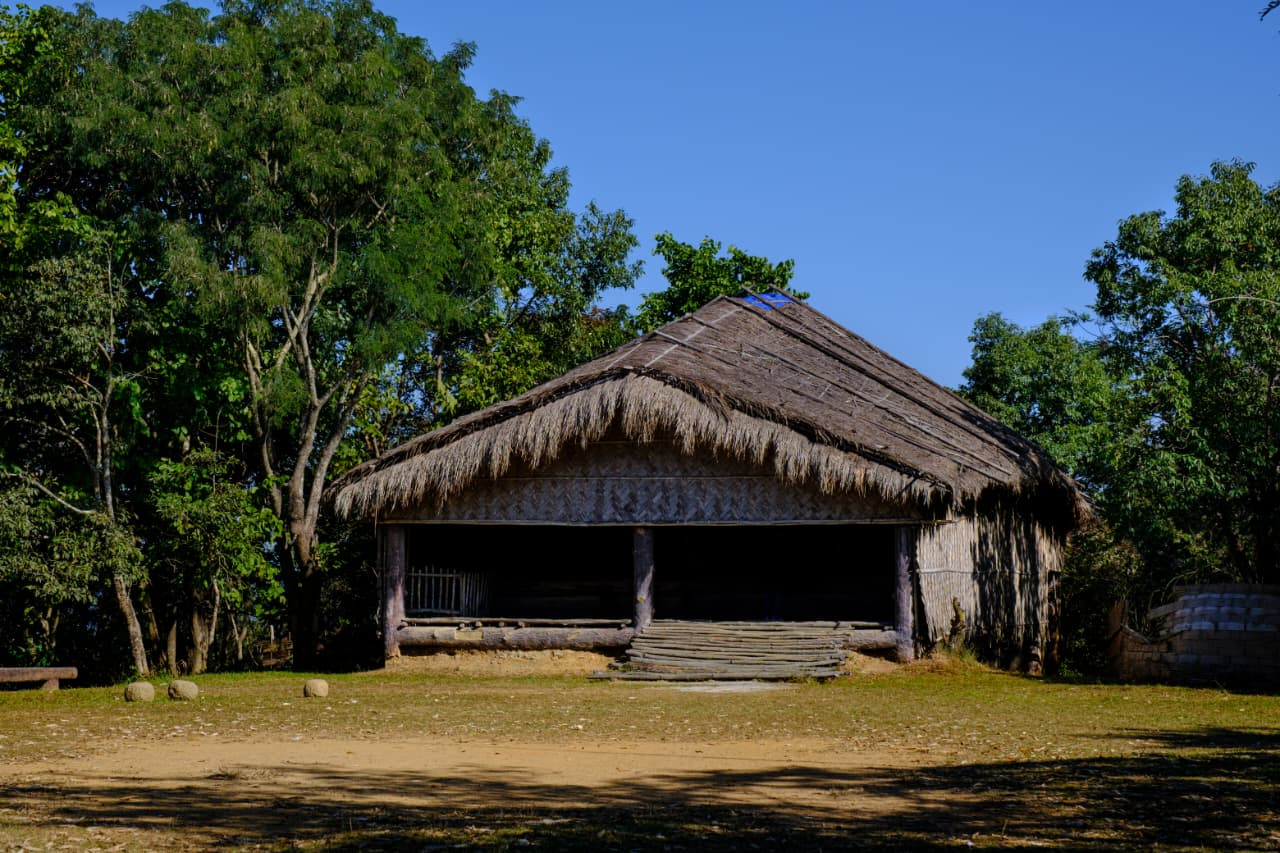
ZAWLBUK (bachelors’ dormitory)
A big house called "Bachelors' dormitory” was built almost in every village. All unmarried and newly married young men generally above fifteen (15) years of age were required to sleep there.
Zawlbuk used to be located almost invariably at the most central place in a Mizo village. Situated within a stone-throw of the chief's residence, it used to be a very large dwelling place capable of accommodating all young men and boys in the village. A typical Zawlbuk was constructed through the free labour of all the male members of the village at the command of the chief and was usually erected on stout timber stilts on the slope of a steep ridge.
The entire breadth of the Zawlbuk facing the roadside functioned as its entrance and it started about four feet inside the edge of the platform on which the Zawlbuk was erected. At the point of the entrance, a bamboo wall is fixed up with the entire roof breadthwise, leaving about five feet below it over the platform. The vacant space between the wall and the floor is popularly known as Awkpakawngka. A big log very often with a diameter of about two feet and sufficiently long to cover the entire breadth of the Zawlbuk was placed on the platform about four feet inside the bamboo woven entrance wall, thereby leaving an open space as veranda Luhka. The surface of these logs used to be rubbed out after peeling the bark to give it a smooth and shining appearance. The dwellers had almost to roll over the log to find their place within the Zawlbuk. These logs used to be called Bawhbel in Mizo language was considered as a very valued possession of the Zawlbuk. The dwellers took great pride in making it as beautiful and smooth as they could.
On one side of the open platform Luhka, in front of the entrance, there used to be a place for stocking of firewood Thingnawi bawm. A few strong timber poles placed horizontally one against the other and supported on an inclined structure acted as the staircase Kaiten to the platform of the Zawlbuk. The corner poles and the stilts provided the main supporting force for the structure of the Zawlbuk. On the structure so prepared by fastening timber poles and bamboos on the stilts, a strong floor was constructed so as to make it suitable to serve the purpose of a gymnasium. The floor
Inside the room so constructed, a central portion was set aside for the Zawlbuk fireplace. This used to be a square structure walled up with timber logs rising from the ground underneath the floor. This walled fireplace was filled up with solid earth/soil right from the ground; giving thereby an earthen floor for the Zawlbuk fire smouldering thereon day and night. One of the most frequent pastimes of the Zawlbuk dwellers was to engage themselves in wrestling and various indigenous gymnastic feats on the floor. In fact, one of the recognised and accepted functions of the Zawlbuk was to ensure adequate arrangement for indoor physical exercise for the young folks.
At the back portion of the Zawlbuk, there used to be a raised platform known as Bahzar (Dawvan) about six feet wide and one foot high covering the whole breadth of the Zawlbuk as its length. It was this platform whereon the young members of the Zawlbuk would often sit together to witness gymnastic feats, wrestling performed on the main floor, or to talk about their love affairs and their sweethearts, and are sometimes used as a dance floor. This platform was also used as their sleeping place at night. The Zawlbuk was not only used as a place for sleeping by unmarried youths but also as a Rest House by traveling and visitors to the Village
The back-wall of the Zawlbuk too had an opening running across the whole breadth. This wall consisted of two separate pieces of woven split bamboo matting, one rising three to three half feet from the ground and the other hanging about four feet down from the roof, leaving thereby the opening known as Awkpaka.
Zawlbuk acted primarily as a dormitory wherein all the young lads of the village were expected to sleep in the night. However, it was not only the abode of the youth as it physically represented, but was indeed the crucible wherein the Mizo youth, the marginal man was shaped into the responsible adult member of the society. It constituted the hub of the village, functioning simultaneously as a traveller's inn for the weary ones passing from one village to another, as also a place from where necessary vigilance was continuously maintained to ensure the safety of the village. It also sowed the seed of the wonderful philosophy of Mizo life expressed in TLAWMNGAIHNA, a word, very difficult to be rendered in another language. Nearest to the inner core of this word may perhaps be expressed as altruism, even though it is much deeper in its conceptualisation and much wider in its expressive manifestation. In a nutshell, Tlawmngaihna to a Mizo stand for that compelling moral force which finds expression in self-sacrifice for the service of others. Zawlbuk was indeed a very powerful institution in the village organisation and exercised perhaps the greatest influence in establishing the social norms and customs as also in perpetuating the highly cherished values of the Mizo people.
Upon the Mizo Village and tribal life Zawlbuk exerted a very effective influence. The youths were ever ready for any emergency such as fire, tribal war etc. Training on the art of tribal warfare, wrestling, hunting and village government were imparted to the youths.